



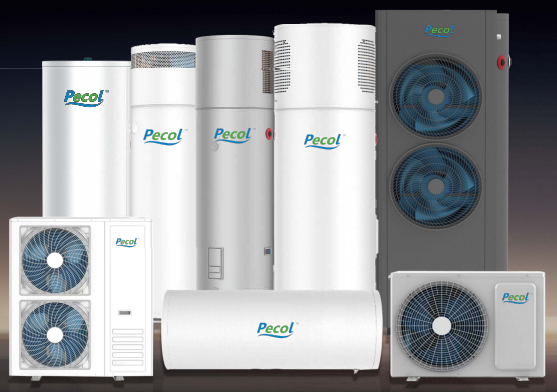
How a split heat pump works
The outdoor unit (compressor, fan and evaporator) collects heat from the air. In a refrigerant circulation split, hot refrigerant flows to a micro-channel heat exchanger wrapped around the indoor tank. In a water circulation split, a built-in pump circulates tank water through a heat exchanger in the outdoor unit. Both keep the tank inside, close to the bathrooms, for short hot water pipe runs.
Refrigerant circulation split (SAHP series)
| Model | SAHP-80/150 | SAHP-80/200 | SAHP-80/300 | SAHP-150/500 |
|---|---|---|---|---|
| Tank capacity | 150 L | 200 L | 300 L | 500 L |
| Heating capacity | 3,360 W | 3,360 W | 3,360 W | 7,200 W |
| Hot water yield | 71 L/h | 71 L/h | 71 L/h | 155 L/h |
| Input / COP | 800 W / 4.2 | 800 W / 4.2 | 800 W / 4.2 | 1,750 W / 4.11 |
| Max outlet temperature | 60°C | 60°C | 60°C | 60°C |
| Working ambient | -5 to 43°C | -5 to 43°C | -5 to 43°C | -5 to 43°C |
| Outdoor noise | 52 dB(A) | 52 dB(A) | 52 dB(A) | 55 dB(A) |
| Outdoor unit (L×W×H) | 765×260×530 mm | 765×260×530 mm | 765×260×530 mm | 800×300×540 mm |
R410A, rotary compressor, electronic expansion valve. Enamel-coated steel tank (0.3–0.5 mm enamel), magnesium anode, 50 mm PU insulation, 2 kW backup element, 0.8 MPa.
DC inverter water circulation split (DCSAHP-300/500HW)
| Specification | DCSAHP-300/500HW |
|---|---|
| Tank options | 300 L / 500 L |
| Max heat pump output | 7,600 W (average 6,596 W) |
| Heat pump input / COP | 1,440 W / 4.58 |
| Compressor | Panasonic twin rotary inverter |
| Refrigerant | R32 (800 g) |
| Operating ambient | -15 to 45°C |
| Max hot water (hybrid) | 75°C |
| Noise | ≤55 dB(A) |
| Backup element | 3 kW |
| Water proofing | IPX4 |
| Heat pump to tank distance | up to 5 m |
| Extras | WiFi colour controller, ECO and HYBRID modes, optional PV solar connection, optional cooling water 5–18°C |
The DC inverter adjusts compressor and fan speed to demand, so it heats quickly when the tank is cold and slows down to save energy when it is nearly at temperature.
When to choose a split system
- The tank must be indoors (for example in a condo store room or roof space) but the heat pump can sit on a balcony, roof or outside wall.
- You need a larger tank (300–500 L) for a big family.
- You want WiFi control, an optional connection to rooftop solar PV, or the quietest indoor area.
- You are replacing an old indoor storage heater and want to reuse its location.
Frequently asked questions
What is the difference between a split and an all-in-one heat pump?
An all-in-one puts the heat pump and tank in one cabinet. A split separates the outdoor heat pump from the indoor tank, connected by pipes.
How far can the outdoor unit be from the tank?
For the DC inverter water circulation model, up to about 5 metres. Longer runs need an engineer's check.
Is an inverter heat pump worth it?
Inverter models run more efficiently at part load, are quieter and handle a wider temperature range. They suit families with varying hot water use.