



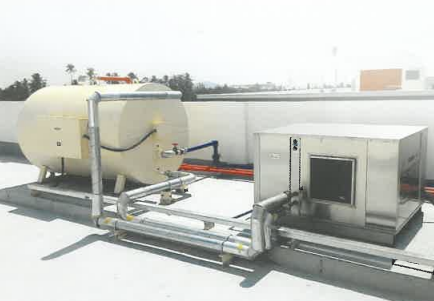
Industrial applications
Food & beverage
Washing, blanching, cleaning in place and sanitation.
Factories
Parts washing, degreasing, pre-treatment and canteens.
Laundries
Wash water with cold exhaust air to cool the laundry.
Agriculture
Animal husbandry, nurseries and processing.
Workers' facilities
Showers in hostels and staff quarters.
Heat recovery
Use cold air or chilled water as a by-product.
Suitable Pecol units
| Range | Capacity | Max outlet | Notes |
|---|---|---|---|
| PHM commercial heat pumps | 3–40 HP | 60°C (Class II) | With PACHM calorifiers 454–9,080 L |
| Commercial air to water, fixed speed | 12–103 kW | 60°C | R410A / R407C, top discharge |
| Commercial air to water, EVI | 12–103 kW | 60°C | Wide ambient -25 to 45°C |
| High water temperature (R134A) | 6–89 kW | 80°C | For process and laundry |
| Commercial DC inverter + EVI | 33–80 kW | 60°C | Heating and cooling, 380–415V |
Why use a heat pump in a factory?
- Up to 75% lower hot water energy cost than electric heating, and much lower than diesel boilers.
- No fuel deliveries, storage or emissions on site.
- Simultaneous cooling: cold exhaust air or chilled water reduces air-conditioning load.
- Supports energy audits and carbon-reduction targets.
Worked example: food processing plant
- A plant uses 5,000 L of 60°C water per day for washing and cleaning.
- Heat needed: 5,000 × 33 ÷ 860 ≈ 192 kWh of heat per day.
- Electric heating would use about 192 kWh of electricity per day; a Class II heat pump at COP 4 uses about 48 kWh.
- Over 12 operating hours, about 16 kW of heat output is needed, so a PHM 5 (about 15 kW at Class II) or a 20 kW commercial air to water unit, with a PACHM600 (2,724 L) calorifier for the morning wash-down peak.
Illustrative only. Pecol engineers calculate your actual demand, peak flow and temperatures before recommending equipment.
Designing a process hot water system
Pecol engineers start with your hot water temperature, daily volume and peak flow, then select heat pumps, storage and controls. Where very high temperatures are needed, a heat pump can pre-heat water to 60–80°C and an existing boiler tops it up, which still cuts fuel use significantly.
Frequently asked questions
What temperature can an industrial heat pump reach?
Pecol's high-temperature R134A units reach up to 80°C outlet water.
Can a heat pump work alongside our boiler?
Yes. Many plants use the heat pump for pre-heating and keep the boiler for top-up or standby.