



Heat pump vs air-con: what's the difference?
| Air-conditioner | Heat pump water heater | |
|---|---|---|
| Moves heat from | Inside the room | Outdoor air |
| Moves heat to | Outside (wasted) | Your water tank |
| Main output | Cool room air | Hot water |
| By-product | Hot exhaust air | Cool, dry exhaust air |
Pecol does not sell standalone air-conditioners or furnace/AC combination units. Instead, we help you capture the value of both sides of the cycle.
Three ways to get heating and cooling together
1. Reversible air to water heat pump
Makes hot water and chilled water (5–20°C) for fan coil units from one outdoor unit. Learn more.
2. Free cold air from a heat pump
Commercial heat pumps exhaust large volumes of cold air that can cool laundries, kitchens, stores or lift motor rooms. Learn more.
3. Hot water from your air-con
The Pecol Hybrid Hot Water Storage Heater captures waste heat from a split air-con to heat water at near-zero cost. Learn more.
For homes
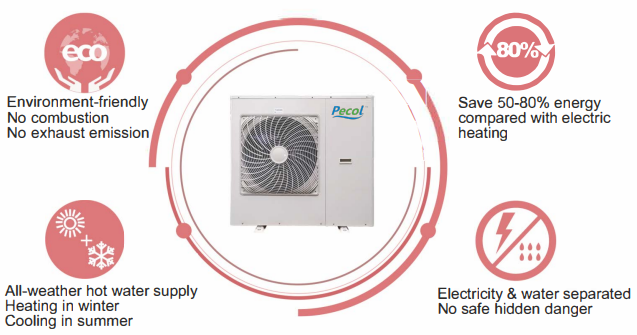
In a bungalow or large house, a reversible air to water heat pump can serve fan coils in living areas and heat the hot water tank at the same time, in mode 4 (hot water + cooling). In a typical home with split air-cons, the simplest step is a heat reclaim water heater connected to one of the air-con units.
For commercial buildings
Hotels, hospitals and factories have both large hot water needs and large cooling loads. A heat pump placed in a laundry or kitchen gives hot water and spot cooling together; buildings with chillers can recover condenser heat with a water-to-water heat pump. See commercial sizing.