


What does an air source heat pump do?
It does three jobs: it absorbs heat from outdoor air, upgrades that heat to a higher temperature using a compressor, and delivers it into water. The result is hot water for showers, taps and kitchens, a heated pool, or warm water for heating, using a fraction of the electricity of an element heater.
How it works (with diagram)
Where does the heat come from? Air at 25–35°C contains a lot of heat energy. The refrigerant in the evaporator boils at a much lower temperature, so it absorbs that heat even from air that feels only warm. In technical terms this is the reverse Carnot cycle. For water-side details see how an air to water heat pump works.
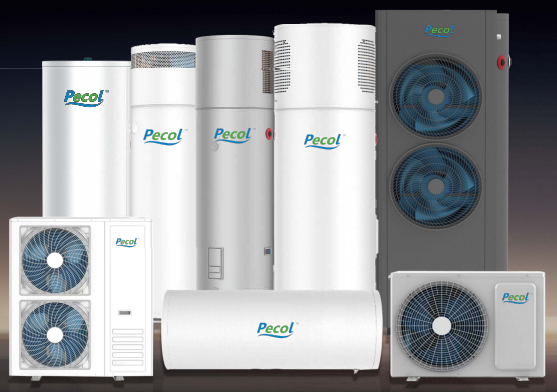
Types of air source heat pump
| Type | Description | Pecol range |
|---|---|---|
| All-in-one (integrated) | Heat pump on top of or beside the tank | Domestic all-in-one |
| Split | Outdoor heat pump, indoor tank | SAHP / DCSAHP split |
| Monobloc air to water | Outdoor unit heats water for a separate tank | WHP series |
| Commercial | High capacity units with calorifiers | PHM series |
| Hybrid | Heat pump plus electric booster or air-con heat reclaim | Hybrid |
| 3-phase / large | For bungalows and commercial buildings | 380–415V models |
Advantages and disadvantages
Advantages
- Uses 50–80% less energy than electric heating.
- Renewable heat source with no combustion.
- Works at night and in the rain, unlike solar.
- Long life and low maintenance.
Disadvantages
- Higher upfront cost than electric heaters.
- Needs outdoor space with good airflow.
- Makes some fan noise (Pecol domestic models 40–45 dB(A)).
- Must be sized and installed correctly.
Performance in the monsoon season
During heavy rain the air cools by a few degrees, so heating takes slightly longer, but the heat pump keeps working. Units are weatherproofed for outdoor use, and the backup element covers peak demand. Compared with solar water heaters, this is a key advantage during the November to March monsoon on the east coast.
How much is an air source heat pump?
Price depends on capacity, type and installation. See air source heat pump price and running cost and domestic heat pump costs. Overseas prices for whole-house heating systems in the UK, Ireland or Canada are not comparable with Malaysian hot water systems.